Lessons from the VAS pilot phase: Every 1 Dong of technical assistance mobilizes 63 Dong of investment
Hanoi, September 2026 – The DEPP Programme has released its report on the Performance and Impact of the Pilot Scheme for High-Quality Technical Assistance to Industrial Energy Efficiency in Vietnam. The report summarizes more than two years (2024–2026) of implementation of the Voluntary Agreement Scheme (VAS), which supports industrial enterprises in identifying and developing investment-ready energy efficiency projects.
Key energy-consuming industrial enterprises are required to conduct energy audits once every three years. However, with conventional energy audit reports alone, they struggle to make investment decisions due to a lack of the necessary technical and financial analysis. On top of that, solutions with high potential but embedded deep within production processes are often overlooked when an audit's objective is limited to "compliance" with legal requirements.
The VAS pilot tested a different approach: combining internationally standardized energy audits with pre-feasibility and feasibility studies to help enterprises identify and develop projects to the point of being investment-ready.
Key findings
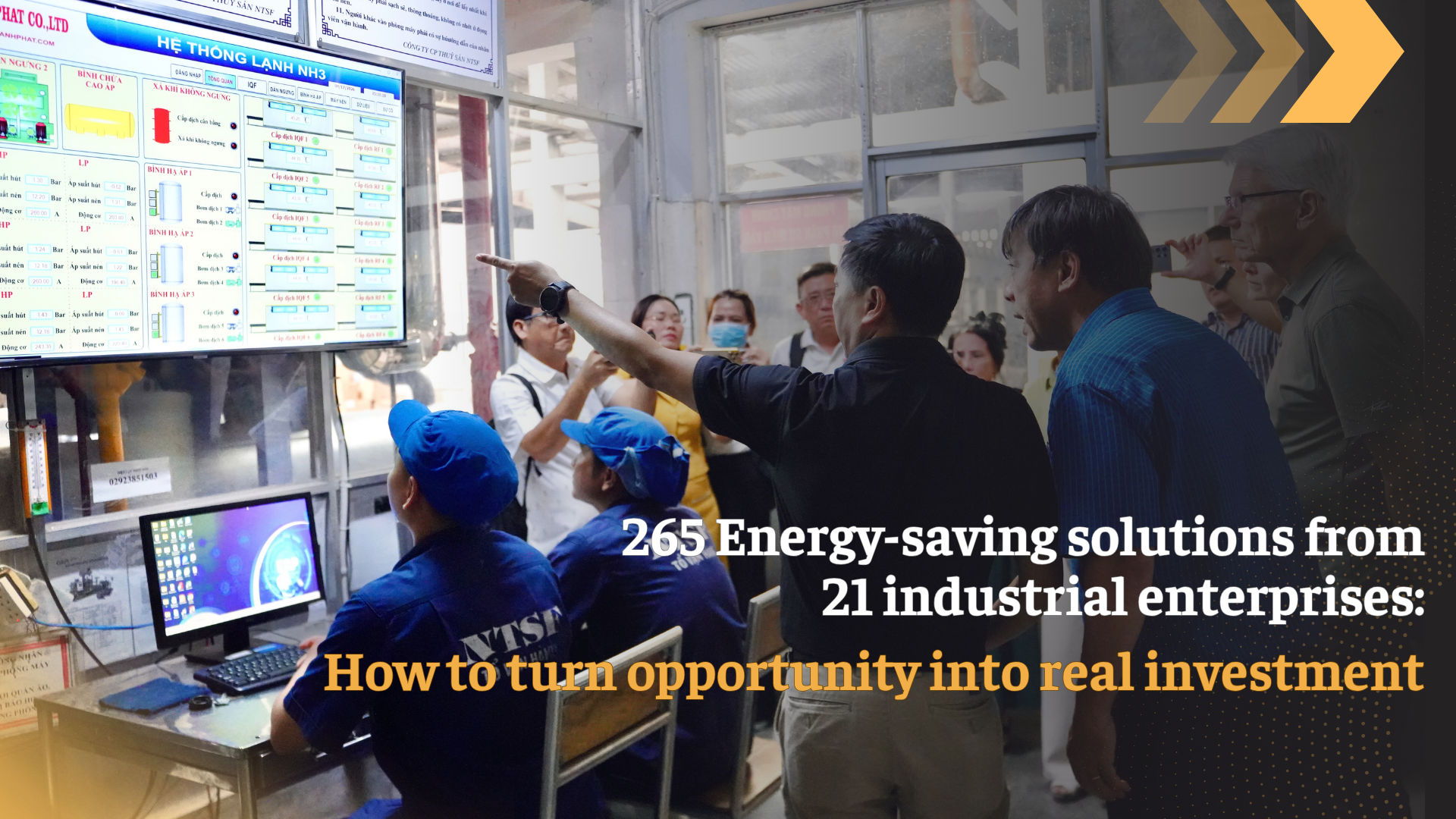
With 21 enterprises across 13 industrial sectors participating, the Programme identified 265 energy efficiency solutions with a combined potential to save about 508 GWh and reduce roughly 206,000 tonnes of CO2 emissions annually — equivalent to an investment pipeline of approximately 983 billion VND.
Notably, more than half of the projects are not just on paper: 81 have already been implemented and 66 are in enterprises' implementation plans. Once implemented, 147 projects will help cut about 315 GWh and 139,300 tonnes of CO2 per year.
The average payback period for the projects is only about 2.8 years. In addition, the leverage ratio reached 63:1 — meaning every dong of technical assistance mobilized 63 dong of investment capital. This shows that well-structured technical assistance can significantly unlock investment capital for energy efficiency.
The report also points to where the greatest saving potential is "hidden": thermal solutions - such as boilers, kilns, and thermal process optimization - contribute up to three quarters of total energy savings.
By measure category, control and automation offer the biggest potential, representing 52% of overall savings, including application of emerging technologies like machine learning. This underscores the immense potential of leveraging digitalization and new technologies to drive energy efficiency across Vietnam’s industrial sector.
Institutionally, the VAS voluntary agreement model is now among the instruments considered under the Energy Efficiency Fund, as reflected in the revised Law on Energy Efficiency and Conservation. This lays the groundwork for scaling up the proven lessons and methods of the VAS going forward.
Recommedations
The report puts forward three key recommendations for the next phase:
- Continue providing high-quality technical assistance. This is the key factor in turning opportunities into feasible projects, rather than stopping at the audit report stage.
- Strengthen implementation capacity. This can be done by providing training programmes and long-term technical assistance platforms for Vietnamese energy auditing companies.
- Link technical assistance with financing mechanisms. This is what the Energy Efficiency Promotion Fund now being developed aims to address, in order to strengthen access to capital for investment-ready projects.
The report concludes: the main barrier to industrial energy efficiency in Vietnam is not a lack of economically attractive opportunities, but a lack of projects prepared well enough for investment decisions to be made. Well-structured technical assistance is how this gap gets closed.
CHƯƠNG TRÌNH DEPP3







 21 projects
 13 industries
 15 provinces


.png?w=425&h=239&mode=crop)