Turning energy efficiency into profit: When "low-hanging fruits" can yield significant results
This article summarizes the Conclusions and Recommendations from the report “Survey on the current application and potential of energy efficiency technologies in selected industrial sectors in Vietnam,” under the Vietnam - Denmark Energy Partnership Program for the period 2020 – 2025 (DEPP3).
There is a paradox occurring in many Vietnamese factories: despite owning various energy efficiency technologies such as boilers, air compressors, and refrigeration systems, they are still letting “money slip through their fingers” because they lack the knowledge to use them effectively.
The study “Survey on the current application and potential of energy efficiency technologies in selected industrial sectors in Vietnam” from the DEPP3 Program provides a comprehensive analysis of four common technologies: compressed air, industrial refrigeration, boilers, and ventilation.
Focusing on four key industrial sectors - Textiles, Food Processing, Paper, and Brewery - the report highlights critical "gaps" leading to significant energy waste in the surveyed industries.
In addition to highlighting key issues, the report proposes an action roadmap with solutions ranging from simple, low-cost measures like maintenance to more complex ones such as process optimization and technology upgrades, helping businesses optimize production and enhance competitiveness.
The gap between potential and reality
Survey data from the report shows a large gap between potential and actual action. Many “low-hanging fruits - solutions that are easy to implement at low cost - remain underutilized by most businesses.
In the textile sector, up to 90% of surveyed factories have not fully implemented compressed air leakage control programs. Similarly, 95% of businesses have not established periodic steam trap maintenance procedures.
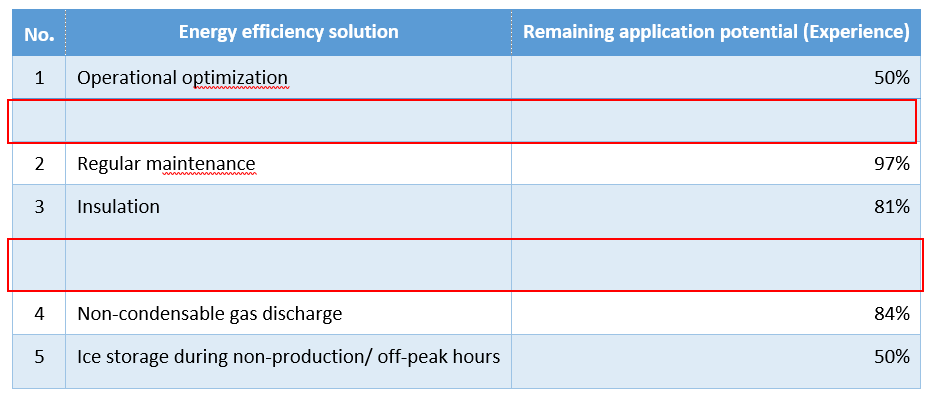
A similar situation occurs in the food processing sector, where 97% of factories still have significant room to improve refrigeration system maintenance, and 84% are missing energy efficiency opportunities from non-condensable gas discharge.
Analysis of energy efficiency potential in industrial refrigeration systems for the food processing sector. Source: DEPP3 Program.
The report points out that achieving energy efficiency does not necessarily require installing entirely new systems. Even simple, easy-to-implement solutions can yield significant energy efficiency benefits if applied correctly.
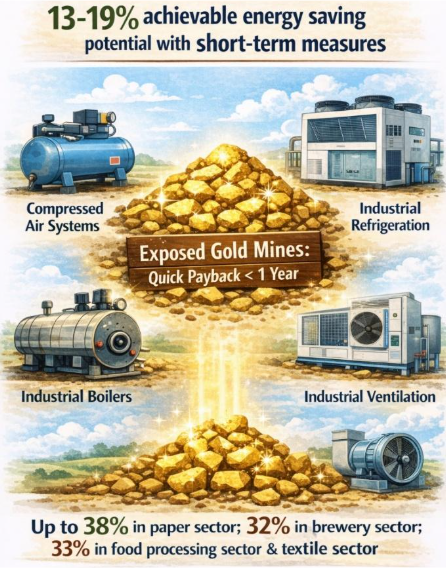
Businesses can achieve energy savings of 13%-19% for the four aforementioned technology systems simply by applying short-term solutions, such as fixing leaks or optimizing pressure.
If combined with medium- and long-term technology investment solutions, the total energy efficiency potential can reach up to 38% in the paper sector and 32% in the brewery sector.
Energy efficiency potential in the short, medium, and long term for all four technologies in selected industrial sectors. Source: DEPP3 Program.
Specifically, in the paper and brewery sectors, the survey indicates that an average energy efficiency of 11% can be achieved by fixing air leaks or optimizing boiler controls. Both solutions are simple, with payback periods of less than one year. These are "open gold mines" that many businesses are overlooking.
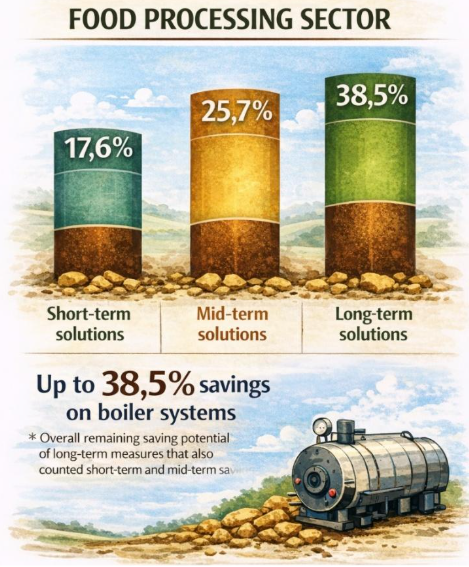
For boilers, if combined with medium- and long-term technology investment solutions, the total energy efficiency potential can reach 35-38% across all four sectors.
The paper and food processing industries have the largest energy efficiency margins if solutions related to compressed air or boiler systems are applied. The energy efficiency potential can reach up to 40% for compressed air systems and 38% for boiler systems when combining smart operations with moderate technical upgrades, such as operational optimization and leak reduction.
Energy efficiency potential in the short, medium, and long term for boiler systems in the food processing sector. Source: DEPP3 Program.
Barriers in awareness and skills
According to Mr. Ma Khai Hien, Director of the Energy Conservation Research and Development Center (ENERTEAM), the main obstacle lies not in technology but in people.
“The lack of monitoring data and the habit of operating based on old experience are hindering the ability to exploit systems more effectively”, Mr. Hien shared.
According to expert Ma Khai Hien, to overcome this, businesses need to apply two main strategies. One is regular inspections to prevent energy loss. Second, hiring qualified personnel is also crucial to operating equipment systems efficiently.
“Higher energy efficiency levels can be fully achieved if businesses recruit trained energy managers, combined with hiring energy auditors and external experts”, Mr. Ma Khai Hien noted.
The report provides information on common mistakes and recommended solutions, from simple to relatively complex, thereby supporting businesses in identifying simple solutions that can be implemented immediately to cut operating costs and increase profits.
With a practical perspective, clear data, and recommendations, we hope this report serves as a valuable reference for businesses, associations, and energy efficiency consulting units.
• Explore the Quick Assessment Tool developed from the report: [
Checklist]
• Reference the full report here: [
Link]
For more information, please contact: - Ms. Nguyen Huong Giang | Phone: +84 8370 444 44
- DEPP3 Office | Address: Room 318, Building B, 54 Hai Ba Trung, Cua Nam Ward, Hanoi
- Website: depp3.vn | coe.depp3.vn
|
DEPP3 PROGRAM







 21 projects
 13 industries
 15 provinces



.png?w=425&h=239&mode=crop)